
Communications on the power grid has generally been implemented with a PDH or SDH network. One reason for this is because as a mature medium, SDH/SONET is stable, reliable, and has a collective body of tools and expertise. A general topology implemented with Loop products is shown below.
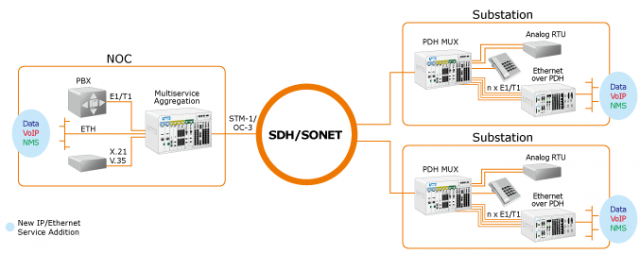
The Loop O9500 nodes as part of a SDH/SONET ring or core network. At the NOC (Network Operations Center), the O9500 has both low speed PBX and X.21/V.35 as well as faster Ethernet connections. At the substations, the O9500 directly connects again to PBXs and an Analog RTU for control. The signal is also diluted for low speed access in the AM3440. The flexible AM3440 can then connect with a wide variety of standards and interfaces such as C37.94 Low Speed Fiber Optical.
However, eventually the problems of scaling and efficiency that have already hit the carrier world are beginning to affect communications for power companies as well. This is because as the reach of the smart power grid grows, it needs to become more distributed and avoid bottlenecks.
Furthermore, some applications send large, unexpected, bursty messages. A connection with the general Internet may be desired too.
Eventually, the problems will grow too large and there will be a need/desire to switch to a core network based on IP. This is a packet switched network as compared to a TDM (time division multiplexing network) of SDH/SONET. It is like switching between a transportation network of trains to one of roads. With the O9500, all that is needed is a TDMoE card to convert between the two formats. The O9500 can now connect to an IP network.
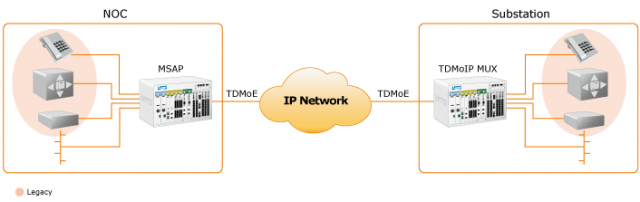
This can also be accomplished on the AM3440.
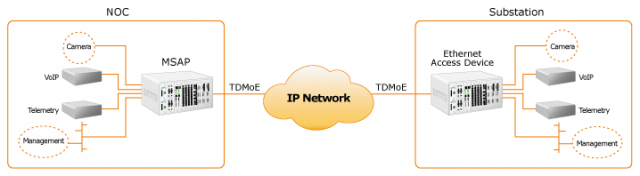
Products from Loop Telecom include the O9550, a cross-connect rack similar to the AM3440, but with aggregation into STM-1/4 lines instead of to E1/T1 as in the AM3440.